Abyss Font for Editorial Design and Creative Projects
As I sat down to redesign the header of a lifestyle blog, the choice of font felt like the first step toward setting the tone of the entire publication. The challenge was clear: find a display font that could convey both strength and elegance, something that would stand out without overwhelming the reader. That’s when I discovered Abyss, a specialized display font with a mechanical-and-maritime soul.
Abyss for Lifestyle Blog Headers and Editorial Branding
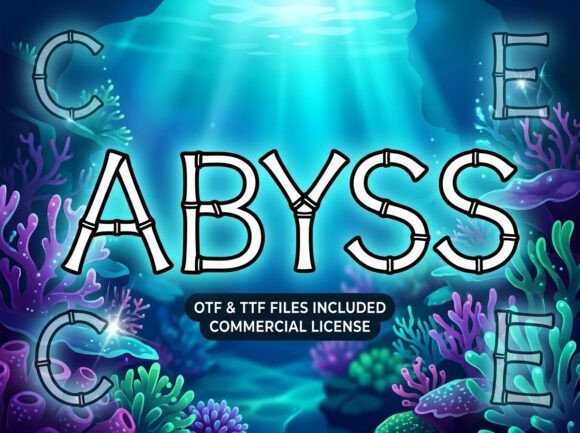
Abyss immediately caught my attention with its bold, hollow letterforms uniquely constructed to mimic the essence of deep-sea exploration and industrial machinery. This font feels like it belongs on the cover of a maritime journal or the title page of an engineering manual. When applied to a lifestyle blog header, it brought a sense of depth and sophistication that elevated the entire design.
The mechanical texture of Abyss added a layer of intrigue, while the hollow forms gave the text a dynamic rhythm. It wasn’t just a font—it was a visual anchor that pulled the reader in, making them curious about what lay beneath the surface of each article.
How Abyss Enhances Visual Hierarchy in Blog Layouts
Using Abyss as the main headline font allowed me to create a strong visual hierarchy. Its weight and contrast naturally drew the eye, making it ideal for titles and section headers. For body copy, I paired it with a clean sans serif font, ensuring readability didn’t suffer. This font pairing created balance between editorial authority and approachability.
I found that Abyss worked especially well for pull quotes and feature titles. The mechanical undertones made it feel purposeful, while the hollow letterforms gave it a unique flair that stood apart from more conventional typefaces.
Abyss for Recipe Ebooks and Culinary Publications
Next, I experimented with using Abyss in a recipe ebook. The idea was to bring a sense of adventure and craftsmanship to the pages. I used it for chapter titles and section headings, letting the mechanical nature of the typeface mirror the precision of cooking techniques.
What surprised me was how well Abyss adapted to different scales. On a large format, it commanded attention like a ship’s nameplate. In smaller sizes, it still maintained clarity and impact—something I hadn’t expected from a display font with such distinctive features.
Readability Considerations for Long-Form Content
While Abyss is best suited for headlines and decorative elements, I did test it in short captions and sidebars. It performed well in these roles, but I wouldn’t recommend using it for long-form content. The hollow letterforms can be challenging to read in extended passages, especially on mobile devices.
This led me to use it selectively—reserving it for titles, pull quotes, and section openers. By doing so, I ensured that the font supported the overall reading experience without becoming a distraction.
Abyss for Wedding Guides and Elegant Event Publications
In another project, I designed a wedding guide using Abyss as the primary typeface. The goal was to create a publication that felt both timeless and adventurous. I used Abyss for the cover title and chapter headings, giving the guide a sense of grandeur and mystery.
The mechanical-and-maritime soul of Abyss added an unexpected twist to a traditionally romantic theme. It helped differentiate this guide from others on the market, making it stand out in a crowded space. Readers seemed to appreciate the uniqueness of the font, noting that it conveyed a sense of journey and transformation.
Font Pairing for Cohesive Editorial Design
To ensure consistency throughout the guide, I paired Abyss with a classic serif font for body text. This combination created a natural flow between the bold, decorative display font and the more traditional, readable type. It also allowed me to maintain a cohesive brand identity across all sections of the publication.
For accents and decorative elements, I used subtle variations of Abyss, including ligatures and alternates, to add visual interest without overwhelming the reader. These details helped reinforce the font’s personality and contributed to the guide’s overall aesthetic.
Abyss for Coaching Workbooks and Educational Materials
Finally, I tested Abyss in a coaching workbook. The objective was to create a resource that felt both professional and inspiring. I used it for chapter titles and key takeaways, allowing the typeface to highlight important concepts and encourage engagement.
The mechanical character of Abyss lent itself well to themes of structure and discipline. It provided a sense of authority that complemented the educational tone of the workbook. At the same time, its maritime undertones introduced a sense of exploration and discovery, making the learning process feel more dynamic.
Overall, Abyss proved to be a versatile font that could adapt to a wide range of editorial needs. Whether used in a lifestyle blog, recipe ebook, wedding guide, or coaching workbook, it consistently delivered a strong visual presence and a compelling narrative.